
 October 21, 2026
 Professional magazine and portal dedicated to electronics
 Tektronix Unifies Power and Signal Integrity Analysis for Modern Power Distribution Networks
Author: Jan Robenek
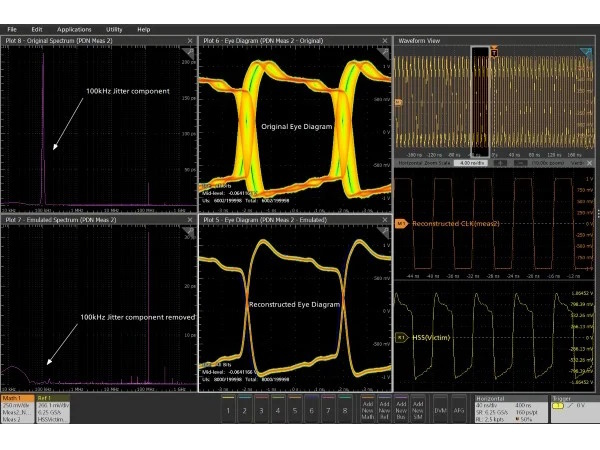
Tektronix introduced its Power Distribution Network (PDN) Analysis Software for 4 Series B, 5 Series B, and 6 Series B Mixed Signal Oscilloscopes. By combining power integrity and signal integrity validation into a single workflow, the solution helps hardware designers evaluate power rail stability, identify sources of noise, and understand how power delivery affects signal performance.
The scaling of modern electronic architectures—specifically AI servers, high-performance compute, and advanced automotive electronics—fundamentally alters the demands on power distribution networks. Delivering fast-changing currents of 1000 A or higher and tighter voltage tolerances, these modern power networks must respond to rapid transient step loads without causing bit errors on critical high-speed data links.
Historically, validation teams have diagnosed the stability of these PDNs using frequency-domain measurements on standalone vector network analyzers. While effective for small-signal measurements, these workflows cannot capture real-world performance under active, high-current load conditions. They also require engineers to access voltage regulator feedback loops, which are often inaccessible in modern designs.
Step-load measurements better reflect the dynamic conditions under which today’s power distribution networks operate and do not require access to voltage regulator feedback. Building on the Stability Evaluation for Power Integrity Analysis (SEPIA) methodology pioneered by Picotest, Tektronix is the first to embed SEPIA directly into an oscilloscope, enabling engineers to evaluate power supply and voltage regulator behavior using real load-transient conditions without breaking control loops and modifying boards (more info).
robenek@dps-az.cz
