
 October 01, 2026
 Professional magazine and portal dedicated to electronics
 Murata Launches Ultra-Low Power AMR Sensors to Boost Battery Life in Healthcare and Wearables Devices
Author: Jan Robenek
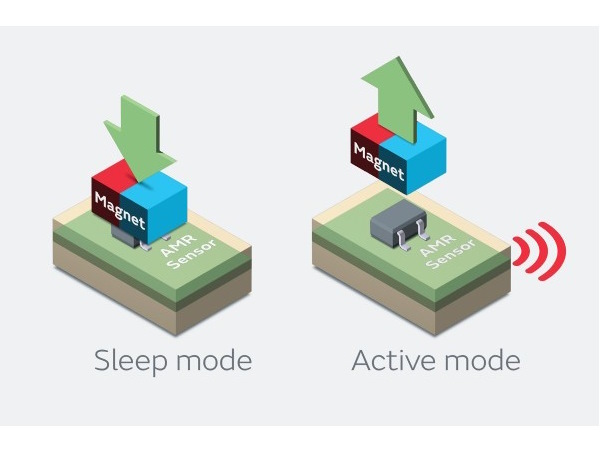
Murata Manufacturing has commenced mass production of its MRMS166R and MRMS168R anisotropic magnetoresistance (AMR) sensors for healthcare, wearable, and IoT devices. The MRMS166R is the first AMR sensor to combine an average current consumption of 20 nA with operation from a 1.2 V supply, enabling extended battery life in coin cell-powered systems.
The devices are solid-state magnetic sensors used for switching applications. They detect the presence or absence of a magnetic field and generate an output signal that system logic uses to control functions such as transitions between active and sleep modes. This enables contactless switching without mechanical components, improving reliability, and supporting sealed, miniaturized designs.
Both devices are housed in a compact package measuring 1.0 × 1.0 × 0.4 mm (0.04 × 0.04 × 0.02 inches), making them suitable for space-constrained designs. The MRMS166R operates over a 1.2 to 3.6 V supply range (1.5 V typ.) with an average current consumption of 20 nA and a maximum current output of 1 mA. The MRMS168R operates over a 2.0 to 3.6 V supply range (3.0 V typ.), with an average current consumption of 80 nA and a maximum output current of 12 mA, providing higher output drive capability for devices requiring increased load current (more info).
robenek@dps-az.cz
